





Introduction
Emotion regulation (Gross, Reference Gross2015) involves the ability to manage and modify, in a socially acceptable manner, emotional responses for adaptive functioning (Campos et al., Reference Campos, Frankel and Camras2004; Cole et al., Reference Cole, Michel and Teti1994). By contrast, emotional dysregulation encompasses (1) emotional expressions and experiences that are excessive in relation to social norms and context inappropriate; (2) rapid, poorly controlled shifts in emotion (lability); and (3) the anomalous allocation of attention to emotional stimuli (Philip Shaw et al., Reference Shaw, Stringaris, Nigg and Leibenluft2014). Effective emotion regulation is essential for several positive outcomes across childhood and adolescence, including social competence (Blair et al., Reference Blair, Perry, O'Brien, Calkins, Keane and Shanahan2015; Penela et al., Reference Penela, Walker, Degnan, Fox and Henderson2015), academic success (Graziano et al., Reference Graziano, Reavis, Keane and Calkins2007; Wong et al., Reference Wong, Colasante and Malti2023), mental health (Kovacs et al., Reference Kovacs, Joormann and Gotlib2008; Zsigo et al., Reference Zsigo, Sfärlea, Lingl, Piechaczek, Schulte-Körne, Feldmann and Greimel2023), and well-being (Chervonsky & Hunt, Reference Chervonsky and Hunt2019; Flouri et al., Reference Flouri, Midouhas and Joshi2014; Perry et al., Reference Perry, Dollar, Calkins, Keane and Shanahan2020), but also for positive outcomes across the lifespan (Riediger & Bellingtier, Reference Riediger and Bellingtier2022). In early and middle childhood, the capacity to regulate emotions is particularly crucial, as it lays the foundation for social, emotional and cognitive development: children who struggle with emotion regulation tend to face more challenges in social interactions (Contreras et al., Reference Contreras, Kerns, Weimer, Gentzler and Tomich2000; Elhusseini et al., Reference Elhusseini, Rawn, El-Sheikh and Keller2023) and learning environments (Harrington et al., Reference Harrington, Trevino, Lopez and Giuliani2020).
Research has shown that in children, as in adults (Parikh et al., Reference Parikh, McGovern and LaBar2019), self-distancing can help with emotion regulation during an emotionally charged task. Self-distancing, or psychological distance, is a subjective experience that something is close or far away from the self, here and now, and emotion regulation is generally easier when one responds to events that are psychologically distant rather than close (Fujita, Reference Fujita2008). In turn, an event is psychologically distant when it is not part of one’s immediate, direct experience, such as when it is “far” in time (now vs. later), space (here vs. there), familiarity or normative social distance (me vs. you, us vs. them), and hypotheticality (certain vs. uncertain, real vs. not real) (Liberman & Trope, Reference Liberman and Trope2008).
Importantly, psychological distance is embedded in our very words. That is, it is not necessary to reimagine negative events as happening far away to feel better about them. Research in psycholinguistics has shown that one could simply shift one’s language to be more “distant” (i.e., engaging in linguistic distancing) with the same effect (Pennebaker & King, Reference Pennebaker and King1999). Effectively, this is distanced self-talk which leverages the structure of language to promote emotion regulation by cueing reflection on the self using parts of speech (i.e., names and non-first-person pronouns) that are typically used to refer to other people. This allows one to seamlessly adopt the perspective of a distanced observer. The increased psychological distance provided by these linguistic shifts helps reframe negative experiences (Nook et al., Reference Nook, Vidal Bustamante, Cho and Somerville2020). However, temporal distancing (Suksasilp et al., Reference Suksasilp, Griffiths, Sebastian and Norbury2021) can also be an effective self-distancing strategy. Temporal distancing involves viewing a negative experience from a future time perspective. Reflecting on how one will feel “in the future” about a present real-world stressor can reduce current negative affect. Importantly, habitual use of temporal distancing predicts psychological health above and beyond that predicted by other emotion regulation strategies (Bruehlman-Senecal et al., Reference Bruehlman-Senecal, Ayduk and John2016).
As might be expected, self-distancing is a process that matures across development. Temporal distancing, for example, requires the ability for mental travel and thus cannot be taught to and used by very young (i.e., preschool age) children. Although some studies have used creative designs to help preschool age children generate psychological distance (Grenell et al., Reference Grenell, Prager, Schaefer, Kross, Duckworth and Carlson2019), an intriguing possibility is that, even without undergoing self-distancing training, school age children can take a more distanced perspective if they are, simply, better at understanding distance. If so, children with better spatial skills should also be better at emotion regulation. We carried out this study to test this hypothesis. We explored the dynamic association between emotion regulation and spatial ability in middle childhood in a large general-population sample in the UK. Spatial ability is the capacity to understand, visualize, recall, and mentally manipulate the spatial relations among objects, shapes, or locations in space (Alkouri, Reference Alkouri2022; Gilligan-Lee et al., Reference Gilligan-Lee, Hawes and Mix2022; Johnson et al., Reference Johnson, Burgoyne, Mix, Young and Levine2022). In children, it grows incrementally with age until middle adolescence when it plateaus (Farrell Pagulayan et al., Reference Farrell Pagulayan, Busch, Medina, Bartok and Krikorian2006). It is a crucial cognitive skill (Bjorklund, Reference Bjorklund2022; Harrington et al., Reference Harrington, Trevino, Lopez and Giuliani2020; Suri et al., Reference Suri, Sheppes and Gross2013), strongly linked to Science, Technology, Engineering, and Mathematics performance (Gilligan et al., Reference Gilligan, Flouri and Farran2017; Hawes & Ansari, Reference Hawes and Ansari2020; Hawes et al., Reference Hawes, Gilligan-Lee and Mix2022; Xie et al., Reference Xie, Zhang, Chen and Xin2020), problem-solving (Gizzonio et al., Reference Gizzonio, Bazzini, Marsella, Papangelo, Rizzolatti and Fabbri-Destro2022), and navigation (Pullano & Foti, Reference Pullano and Foti2022). It is also sexually dimorphic, although the direction of the sex-related differences varies according to the spatial skill assessed (Cimadevilla & Piccardi, Reference Cimadevilla, Piccardi, Lanzenberger, Kranz and Savic2020).
Crucially for our study aims, some aspects of spatial ability can facilitate inhibitory control, a key self-regulatory process, similar to emotion regulation (Carlson & Wang, Reference Carlson and Wang2007). Frick and Baumeler (Reference Frick and Baumeler2017), for example, observed that visual perspective taking, a process initially based upon spatial alignment of perspectives (Kessler & Thomson, Reference Kessler and Thomson2010), was correlated with inhibitory control in children even when adjusting for socioeconomic status and verbal ability. Visuospatial perspective taking can also support the computation of other people’s mental states (Tanaś & Myslinska Szarek, Reference Tanaś and Myslinska Szarek2021), a social cognitive skill. It can thus promote emotion regulation via social cognition (Gratz & Roemer, Reference Gratz and Roemer2004) to the extent that emotion perception, a core aspect of social cognition, improves the regulation of emotion. Finally, early in development, spatial processing is particularly crucial for establishing mental maps and models (Mix et al., Reference Mix, Levine, Cheng, Young, Hambrick, Ping and Konstantopoulos2016), and therefore understanding causal processes. Thus, in children spatial skills may directly reduce the risk of biased cognition, associated with emotional dysregulation (Joormann & Vanderlind, Reference Joormann and Vanderlind2014). At the same time, the link between spatial ability and emotion regulation may be reciprocal since emotion regulation facilitates task orientation, a precursor of cognitive performance (Gumora & Arsenio, Reference Gumora and Arsenio2002). More broadly, emotional dysregulation has long been shown to interfere with learning (Boekaerts & Pekrun, Reference Boekaerts and Pekrun2015) both directly and indirectly via straining the pupil-teacher relationship, impeding cognitive processing and reducing independent learning behavior (Graziano et al., Reference Graziano, Reavis, Keane and Calkins2007).
The present study
To explore the dynamic link between spatial skills and emotion regulation in middle childhood, we used a large, nationally representative birth cohort from the UK – the Millennium Cohort Study (MCS, 2020) – that also allowed us to control for a host of potential confounders associated with individual, family, and contextual characteristics. In the present study, spatial ability (performance on a pattern construction task) and emotional dysregulation (parent reported) were both available at ages 5 and 7 years, a critical developmental window. Age 5 years is when UK children reach compulsory school age and when the ability to independently execute sophisticated emotion-regulation strategies, such as cognitive restructuring, begins (Stegge & Terwogt, Reference Stegge and Terwogt2007). We tested our hypothesis about a dynamic link between spatial ability and emotion regulation by fitting cross-lagged panel models, before and after adjustment for confounders. Confounders (i.e., factors associated with both spatial and emotion-regulation skills in children) included sex (Domes et al., Reference Domes, Schulze, Böttger, Grossmann, Hauenstein, Wirtz, Heinrichs and Herpertz2010; Lauer et al., Reference Lauer, Yhang and Lourenco2019; Madison, Reference Madison2021; Nolen-Hoeksema, Reference Nolen-Hoeksema2012), ethnicity (Johnson et al., Reference Johnson, Burgoyne, Mix, Young and Levine2022; Weiss et al., Reference Weiss, Thomas, Schick, Reyes and Contractor2022), parental education and income (Kotsopoulos et al., Reference Kotsopoulos, Makosz, Zambrzycka and Dickson2021; Morris et al., Reference Morris, Silk, Steinberg, Myers and Robinson2007), maternal psychological distress and parenting (Bariola et al., Reference Bariola, Gullone and Hughes2011; Guajardo et al., Reference Guajardo, Snyder and Petersen2009), and non-spatial cognitive ability (Casasola et al., Reference Casasola, Wei, Suh, Donskoy and Ransom2020; Lohman, Reference Lohman2013) – assessed in MCS at the previous wave (age 3 years) with a naming vocabulary task. Given the importance of targeting subgroups of children, frequently by sex, for providing effective early support, we also tested for differences in the cross-lagged paths between boys and girls.
Methods
Participants and analytic sample
MCS tracks the progress of around 19,000 children born in England, Scotland, Wales, and Northern Ireland during 2000–2002 (Joshi & Fitzsimons, Reference Joshi and Fitzsimons2016). The sampling frame for MCS, as detailed by Plewis et al. (Reference Plewis, Calderwood, Hawkes, Hughes and Joshi2004), ensured disproportionate representation of families living in high child-poverty areas (electoral wards), and families in England living in areas with at least 30% ethnic minority populations. Data collection took place mainly through interviews with parents (mothers in the vast majority of cases) and test batteries and questionnaires administered in the child’s home. The MCS childhood waves were at age 9 months and 3, 5, 7 and 11 years. In each wave, ethical approval was provided by UK Multicentre Ethics Committees, while informed consent was provided by parents prior to any interviews.
The age 5 wave (the first wave where both spatial skills and emotion regulation were measured in MCS, and hence our starting point) included 15,575 cohort members who were singletons or first-born twins or triplets. We required that cohort members had valid data on both emotional dysregulation and spatial ability at age 5 years. Given this condition, 13,378 cohort members (51% male) remained in the analytic sample.
Measures and procedures
Spatial ability (5 and 7 years)
The assessment of spatial ability was carried out using the Pattern Construction subscale from the British Ability Scales Second Edition (BAS II) (Hill, Reference Hill2005). The task involves a series of challenges where participants are asked to replicate specific patterns using a set of distinct blocks, where the blocks vary in their surface design, featuring either solid colors (yellow or black) or a dual-tone (half-yellow, half-black) scheme. Participants are required to manipulate the blocks through rotation and arrangement to accurately match the given stimulus pattern. As such, the task measures intrinsic-dynamic spatial skills, as categorized by Uttal et al. (Reference Uttal, Meadow, Tipton, Hand, Alden, Warren and Newcombe2013). Performance is evaluated based on the precision of block placement and orientation, as well as the speed of response. In our study, the scaled, age-adjusted variable of performance ranged from 1 to 61, with higher scores indicating better spatial skills.
Emotional dysregulation (5 and 7 years)
The assessment of emotional dysregulation was performed with a scale derived from the Adaptive Social Behaviour Inventory (Hogan et al., Reference Hogan, Scott and Bauer1992), a comprehensive tool measuring various facets of a child’s social and emotion self-regulation skills. The scale, ranged from 1 to 21, was the sum of five items (Cronbach’s a 5 = .65, and a 7 = .67, for ages 5 and 7, respectively) through which the main adult respondent (typically the mother) indicated on a rating scale from 1 to 4 the extent of the child’s display of mood swings, overexcitement, frustration, inability to get over being upset, and impulsive behavior. Higher values correspond to greater levels of emotional dysregulation.
Covariates
These were all measured at age 3 wave as follows. Income was the family’s total income measured in OECD equivalized quintiles. Sex was male or female, as reported by the main respondent. Ethnicity, reported by the main respondent, was based on the categories of the previous UK Census (White, Mixed, Indian, Pakistani and Bangladeshi, Black or Black British, Other Ethnic group including Chinese or Other). Verbal ability was measured with the BAS II Naming Vocabulary subset, which assesses expressive language skills (whereby the child names objects shown in colored pictures). The age-standardised T-score was used in the present study, a numerical variable ranging from 1 to 63. Maternal education was the mother’s highest educational level attained, based on the UK’s National Vocational Qualifications awards and their equivalents (on a scale ranging from 1 to 6). Mother’s psychological distress was measured with the self-reported Kessler 6-item scale, a numerical variable ranging from 1 to 25 (with higher scores indicating higher levels of distress) (Kessler et al., Reference Kessler, Green, Gruber, Sampson, Bromet, Cuitan, Furukawa, Gureje, Hinkov and Hu2010). Finally, mother’s emotional responsivity deficits were measured with a subscale of the Home Observation Measurement of the Environment-Short Form (HOME-SF) (Caldwell and Bradley (Reference Caldwell and Bradley1984). As part of the cohort’s assessment at age 3 years, the interviewer visiting the child’s home assessed the quality of the home environment and mother-child interactions. Here we used the subscale for maternal emotional responsivity, a numerical variable from 0 to 5, where 5 indicates that none of the following warm and responsive interactions took place: voice when speaking of or to the child conveyed positive feeling; mother conversed with the child at least twice during visit, discounting any scolding or negative comments; mother made an effort to answer the child’s questions or requests verbally; mother spontaneously praised the child’s qualities or behavior twice during the visit; mother caressed, kissed or cuddled the child at least once during the visit. The scale had 5 items and standardized Cronbach’s a = .70, with higher values corresponding to greater emotional responsivity deficits.
Analytic strategy
Sample bias, missing data, and pairwise correlations
We performed unweighted, descriptive analyses, first, to identify any differences between participants in the analytic sample and those excluded from it and, second, to ensure that the missingness in our sample was both sufficiently low and did not follow certain patterns (namely, to ensure that values were Missing at Random). This step also informed the imputation process later. To complete the initial analysis, we calculated correlations among the study’s numerical variables.
Survey-weighted, imputed cross-lagged panel models
We fitted three survey-weighted cross-lagged panel models with imputed data. By “survey weighted” we mean that population weights were applied to the models, that is, we made use of the survey-design weights, which were provided by MCS to ensure that the survey sample represented the UK population. Model 1 was unadjusted; Model 2 controlled for sex, ethnicity, family income, maternal education, maternal psychological distress, and mother’s emotional responsivity deficits; finally, in Model 3, we additionally controlled for verbal ability. In a sex-stratified analysis, we refitted the final model separately in males and females and compared the cross-lagged paths. Models 2 and 3 additionally adjusted for the MCS “stratum.” As mentioned, MCS was a stratified sample, and its sampling frame, based on UK electoral wards, ensured disproportionate representation of disadvantaged areas (measured via the Child Poverty IndexI), and areas, in England, of high ethnic minority density. In MCS therefore, each UK country has an advantaged and a disadvantaged stratum (area disadvantage corresponds to the case when a ward was in the upper quartile [poorest 25%] of the Child Poverty Index). In England, there was a third stratum (ethnic minority) that identified areas with at least 30% of the population being “Black” (Black Caribbean, Black African and Black Other) or “Asian” (Indian, Pakistani and Bangladeshi), as defined in the 1991 Census. Missing data were imputed using multiple imputation by chained equations (Raghunathan et al., Reference Raghunathan, Lepkowski, Hoewyk and S.2001), and estimates and standard errors across imputed data sets were combined following Rubin’s rules (Rubin, Reference Rubin1987). Calculations were performed in R (R.Core.Team, 2021) with the “mice” (van Buuren & Groothuis-Oudshoorn, Reference van Buuren and Groothuis-Oudshoorn2011) and “lavaan” packages (Rosseel, Reference Rosseel2012).
Results
Sample bias and missingness
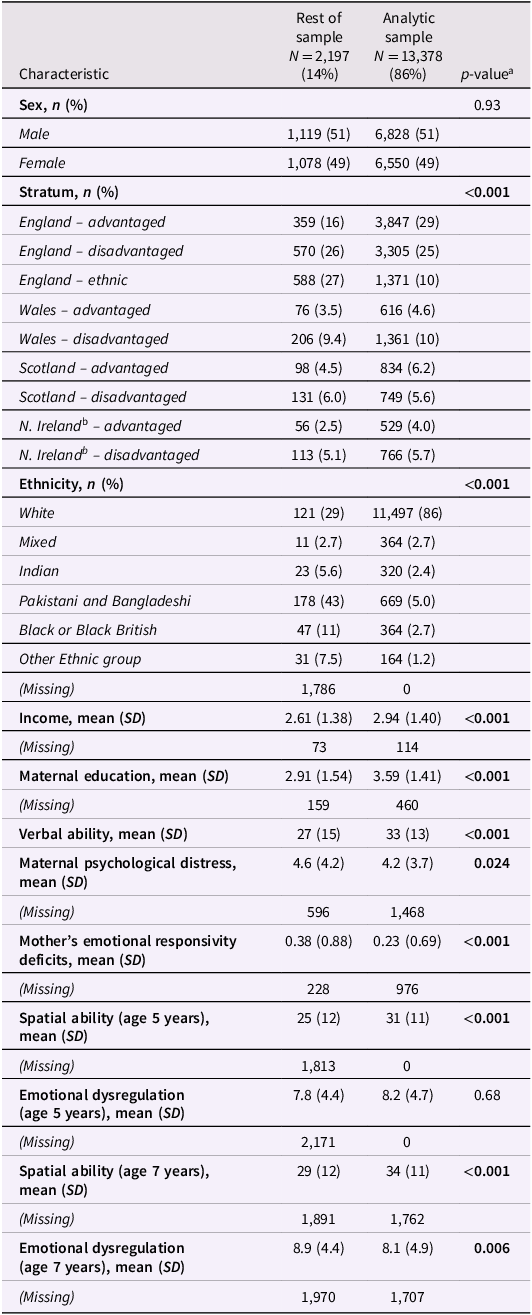
Due to the attrition and non-response patterns typically observed in MCS, the cohort members that were excluded from our analytic sample (14% of the total MCS sample at the age 5 wave) were disproportionally nonwhite and had lower family income (Cohen’s d = − 0.24, 95%CI[−0.28,−0.19]), lower maternal education (d = − 0.46, 95%CI[−0.51,−0.41]), and lower verbal ability (d = − 0.46, 95%CI[−0.51,−0.41]). Full details are provided in Table 1. The analytic sample had complete data on sex, stratum, ethnicity, verbal ability, as well as emotional dysregulation and spatial ability at age 5 years. There were few missing values for family income (114), and between 3% and 11% of values were missing for maternal education, mother’s emotional responsivity deficits, and maternal psychological distress. Finally, 13% of values were missing for emotional dysregulation and spatial ability at age 7 years.Footnote 1
Sample bias: unweighted variable distribution between the analytic sample and the rest of the MCS at age 5 years
a Pearson’s chi-squared or Wilcoxon rank sum test.
b N. = Northern | bold for p < .05.
Correlations
The correlations between all numerical confounders (as well as emotional dysregulation and spatial ability at baseline) are shown in Table 2. The strongest correlation among the confounders was between family income and maternal education (r = .53, n = 12821, p < .001).
Correlations between numerical variables (pairwise complete observations)
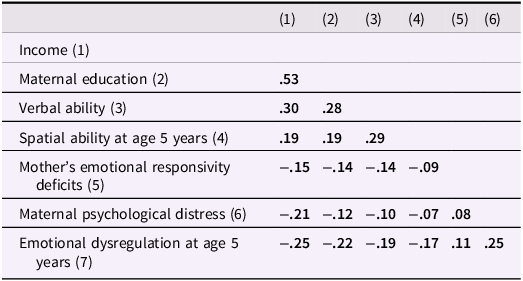
Note. Pearson’s correlation coefficients (bold for p < .05).
Survey-weighted, imputed models
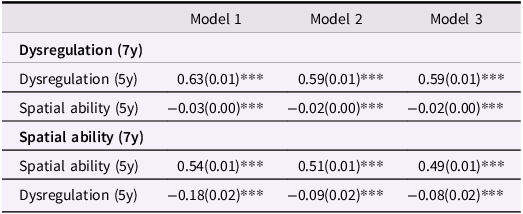
In the unadjusted case (Model 1), the cross-lagged paths were significant and their effect sizes were mediumFootnote 2 : spatial ability at age 5 years was negatively associated with emotional dysregulation at age 7 (b S5 → D7 = − 0.034, se = 0.004, z = − 9.376, p < .001, 95%CI[−0.041,−0.027], standardized coefficient β S5 → D7 = − 0.073), and dysregulation at age 5 was negatively associated with spatial ability at age 7 (b D5 → S7 = − 0.176, se = 0.020, z = − 8.763, p < .001, 95%CI[−0.215, −0.136], β D5 → S7 = − 0.076). The autoregressive paths of spatial ability (β S5 → S7 = 0.518) and emotional dysregulation (β D5 → D7 = 0.612) were also significant, and roughly an order of magnitude stronger than the cross-lagged paths. Full results for this case and the two adjusted models can be found in Table 3.
Cross-lagged panel models [survey-weighted, imputed, unstandardized estimates (standard errors)] for spatial ability (5 and 7 years) and emotional dysregulation (5 and 7 years) (N = 13, 378)
***p < 0.001.
In Model 3, which adjusts for verbal ability as well as all the other confounding variables of Model 2, we found that spatial ability at age 5 years was prospectively negatively associated with emotional dysregulation at age 7 years (b S5 → D7 = − 0.023, se = 0.004, z = − 6.035, p < .001, 95%CI[−0.030,−0.015], standardized coefficient β S5 → D7 = − 0.049), and emotional dysregulation at age 5 was negatively associated with spatial ability at age 7 (b D5 → S7 = − 0.080, se = 0.021, z = − 3.856, p < .001, 95%CI[−0.121,−0.039], β D5 → S7 = − 0.035). Even after full adjustment, therefore, the effects for the cross-lagged paths were significant, albeit now small. A formal test of equality between these standardized coefficients (Klopp, Reference Klopp2020; Rindskopf, Reference Rindskopf1984) did not find evidence of there being a statistically significant difference between the cross-lagged paths. The autoregressive paths were β S5 → S7 = 0.472 for spatial ability, and β D5 → D7 = 0.571 for emotional dysregulation. Full details for this case (and for Model 2) are provided in Table 3, which shows the lagged and cross-lagged associations (for full model results, including confounder effects, see Table A1 in the Appendix). As can be seen there, the results for the two adjusted models had small differences between them, implying that the impact of including verbal ability as a confounder was minimal.
Sex-stratified models
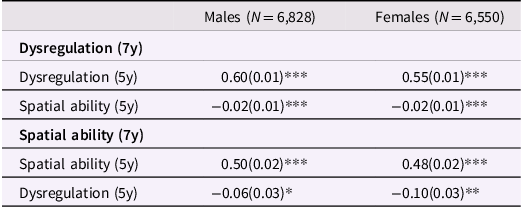
In the sex-stratified, fully adjusted model (Model 3), spatial ability at age 5 was negatively associated with emotional dysregulation at age 7 for both males (b S5 → D7 m = − 0.022, se = 0.005, z = − 4.267, p < .001, 95%CI[−0.032, −0.012], standardized β S5 → D7 m =− 0.049) and females (b S5 → D7 f = − 0.022, se = 0.006, z = − 3.871, p < .001, 95%CI[−0.034,−0.011], standardized β S5 → D7 f = − 0.047). A formal test of the two coefficients (Paternoster et al., Reference Paternoster, Brame, Mazerolle and Piquero1998), β S5 → D7 m and β S5 → D7 f , did not find any statistically significant difference between them. The same held true for the inverse relationship, namely, the prospective association between emotional dysregulation at age 5 years and spatial ability at age 7 years for males (b D5 → S7 m = − 0.064, se = 0.030, z = − 2.127, p = .033, 95%CI[−0.122,−0.005], standardized coefficient β D5 → S7 m = − 0.027) and females (b D5 → S7 f = − 0.097, se = 0.031, z = − 3.098, p = .002, 95%CI[−0.159,−0.036], standardized coefficient β D5 → S7 f = − 0.043). As in the non-sex-stratified case of the previous subsection, there was no statistically significant difference in the cross-lagged paths in either the model for males, or the model for females. The full results of this analysis are presented in Table 4 (for full model results, including confounder effects, see Table A2 in the Appendix).
Fully adjusted cross-lagged panel model [survey-weighted, imputed, unstandardized estimates (standard errors)] for spatial ability (5 and 7 years) and emotional dysregulation (5 and 7 years), stratified by sex
*p < 0.05, **p < 0.01, ***p < 0.001.
Discussion
The results of the present study showed that greater spatial ability at age 5 years is prospectively associated with lower emotional dysregulation at age 7 years, while greater emotional dysregulation at age 5 years is associated with lower spatial ability at age 7 years. These cross-lagged associations remained significant to adjustment for confounders, including sex, ethnicity, verbal ability, family income, maternal education, maternal psychological distress, and mother’s emotional responsivity, but the effect size for both cross-lagged paths was small. There were no sex differences in any of the cross-lagged associations between emotional dysregulation and spatial ability.
These findings are important because they suggest that building children’s spatial skills may support their emotional development over and above any benefits produced by non-spatial cognition. In our study, the association between spatial skills and emotional dysregulation was very robust to controlling for verbal skills. Therefore, this study adds to the rapidly growing evidence for the cross-domain benefits of spatial skills, which, importantly, appear to be malleable to training (Uttal et al., Reference Uttal, Meadow, Tipton, Hand, Alden, Warren and Newcombe2013). If the associations reported here are causal, they suggest that spatial cognitive training in both boys and girls could transfer to nonacademic abilities too. Conversely, strengthening emotion regulation could improve spatial skills, which, in turn, support several areas of learning. These findings have the potential to shape school and education policy and practice, for example by informing curriculum design. They strengthen the case, for instance, for supporting both spatial and socioemotional skills in the early primary school years and for including both these areas of learning in the primary school curriculum.
Nonetheless, there were some unexpected findings too. For example, although we were prepared to see evidence for some modulation of cognition by emotion (Blair et al., Reference Blair, Smith, Mitchell, Morton, Vythilingam, Pessoa, Fridberg, Zametkin, Nelson, Drevets, Pine, Martin and Blair2007), an unexpected finding for us was the equally strong reciprocal association between emotional dysregulation and spatial ability. Perhaps, however, what is even more intriguing is the related finding that spatial skills were less stable over time than one may expect. Even though the two waves were 2 years apart, the change in spatial skills between age 5 and 7 years was just as large as the change in emotional dysregulation, which typically improves quite dramatically across the childhood years (Cole et al., Reference Cole, Ashana Ramsook and Ram2019). This, in turn, speaks to the malleability of spatial skills in middle childhood. Factors influencing this change in spatial ability may include strategy change or environmental factors such as early schooling experiences, exposure to technology or gaming. Identifying these factors could improve understanding of individual differences in spatial skills in childhood.
Our study’s intriguing and novel associations notwithstanding, we must acknowledge six important limitations. First, effect sizes were rather small. Second, it would be useful for our purposes if we had more waves of data (and over a longer developmental window) on emotional dysregulation and spatial ability. This would allow us both to ascertain the existence of possible sensitive periods and to capture within-person change over time. Third, some of our confounders, such as mother’s psychological distress and emotional responsivity, were arguably measured too far in the past. It is possible that both these variables (measured at age around 3 years) may have been “time-modified confounders,” that is, their effects on outcomes change over time. Fourth, MCS may no longer represent contemporary childhood. Our data are about 15 years old, and it would be useful to replicate this work in a more contemporary sample. Fifth, constrained by the data we had available, we assumed that the ability to understand spatial relations (spatial ability) is related to the ability to use psychological distance, or indexes the ability to establish mental maps or the ability of spatial perspective taking. Sixth, also limited by the measures available in MCS, we were only able to explore associations between one type of spatial ability, that is, intrinsic-dynamic skills, and one rather narrow aspect of emotional dysregulation. However, both spatial ability and emotional dysregulation are multidimensional constructs. Spatial ability, for example, includes not only mental rotation and mental folding (the intrinsic-dynamic skills broadly captured by our measure of spatial cognition) but also disembedding, spatial scaling, spatial memory, spatial numerical ability, visual motor integration, and perspective taking – all related but distinct skills. In turn, emotional dysregulation also includes several dimensions, such as decreased emotional awareness, inadequate emotional reactivity, intense experience and expression of emotions, emotional rigidity, and cognitive-reappraisal difficulty (Freitag et al., Reference Freitag, Grassie, Jeong, Mallidi, Comer, Ehrenreich-May and Brotman2023). Future research should expand upon this study to explore the possible reciprocal association between spatial ability and emotional dysregulation in childhood across developmental stages, and with a particular focus on mapping the link between specific spatial skills and specific dimensions of emotional dysregulation.
Supplementary material
The supplementary material for this article can be found at https://doi.org/10.1017/S0954579424001093.


 Open access

